



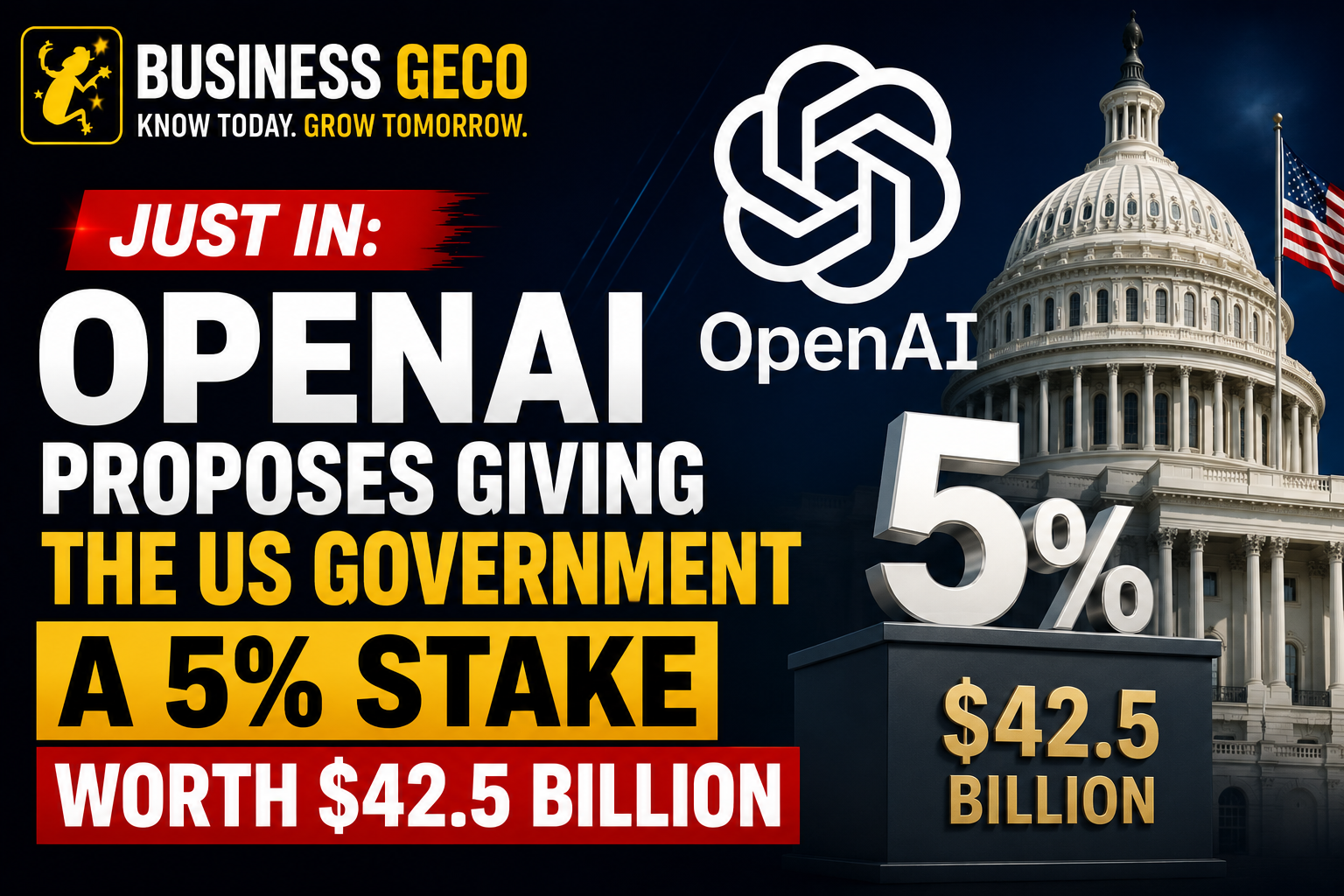
OpenAI Reportedly Proposes Giving U.S. Government 5% Stake Worth $42.5 Billion

By Business Geco Editorial Team | Artificial Intelligence & Business
Introduction
OpenAI has reportedly proposed giving the U.S. government a 5% equity stake in the company, a holding estimated to be worth approximately $42.5 billion based on OpenAI’s recent valuation.
According to reports, the proposal is part of broader discussions on how the public could benefit financially from the rapid growth of artificial intelligence while strengthening cooperation between AI companies and the U.S. government. The discussions are reportedly in an early stage, and no agreement has been finalized.
Subscribe to our newsletter for 24×7 Alerts!
What Is Being Proposed?
The reported proposal would see the U.S. government receive a 5% ownership stake in OpenAI.
The idea is reportedly part of a wider initiative in which other leading American AI companies could also contribute a similar stake to a public investment vehicle, although it remains unclear whether other firms would participate.
Why OpenAI Is Considering The Move
According to reports, OpenAI CEO Sam Altman believes public ownership could allow more Americans to benefit from the economic gains created by artificial intelligence.
The proposal draws inspiration from the Alaska Permanent Fund, which invests state oil revenues and distributes benefits to residents. OpenAI has previously discussed the idea of a “Public Wealth Fund” that could give citizens a financial stake in AI-driven growth.
Still In The Early Stages
Reports indicate that the discussions remain conceptual and that no final agreement has been reached.
Any arrangement involving government ownership could require legislative approval and would likely face significant legal, political, and regulatory review before becoming reality.
Why It Matters
If implemented, the proposal would represent one of the most unusual relationships between the U.S. government and a private technology company.
It could:
- Give the public indirect exposure to AI industry growth.
- Strengthen cooperation between AI companies and policymakers.
- Influence future AI regulation.
- Create a new model for sharing the economic benefits of advanced AI.
Supporters argue that AI’s financial gains should benefit society more broadly, while critics may raise questions about government involvement in private companies.
Growing Government Focus On AI
The proposal comes as Washington increases its attention on artificial intelligence, including issues such as:
- National security
- AI safety
- Competition with foreign AI developers
- Economic impact
- Regulation of advanced AI models
AI companies have faced growing scrutiny as governments seek to balance innovation with public oversight.
The Bigger Picture
OpenAI has become one of the world’s most valuable AI companies, with products including ChatGPT powering millions of users and businesses.
As artificial intelligence reshapes industries worldwide, discussions about who should benefit from the technology’s economic value are becoming increasingly important.
The reported proposal reflects a broader debate over how AI-generated wealth should be shared between private companies and the public.
The Bottom Line
OpenAI has reportedly discussed granting the U.S. government a 5% equity stake, valued at roughly $42.5 billion, as part of broader conversations about public participation in the AI economy.
While the idea remains preliminary and no deal has been reached, it highlights the growing intersection of artificial intelligence, public policy, and economic strategy as governments and technology companies navigate the future of AI.
Tags: OpenAI, Sam Altman, Artificial Intelligence, AI, U.S. Government, ChatGPT, Technology, Business News, Public Wealth Fund, Business Geco, OpenAI, Sam Altman, U.S. government, AI, artificial intelligence, equity stake, Public Wealth Fund, ChatGPT, technology news, Business Geco