



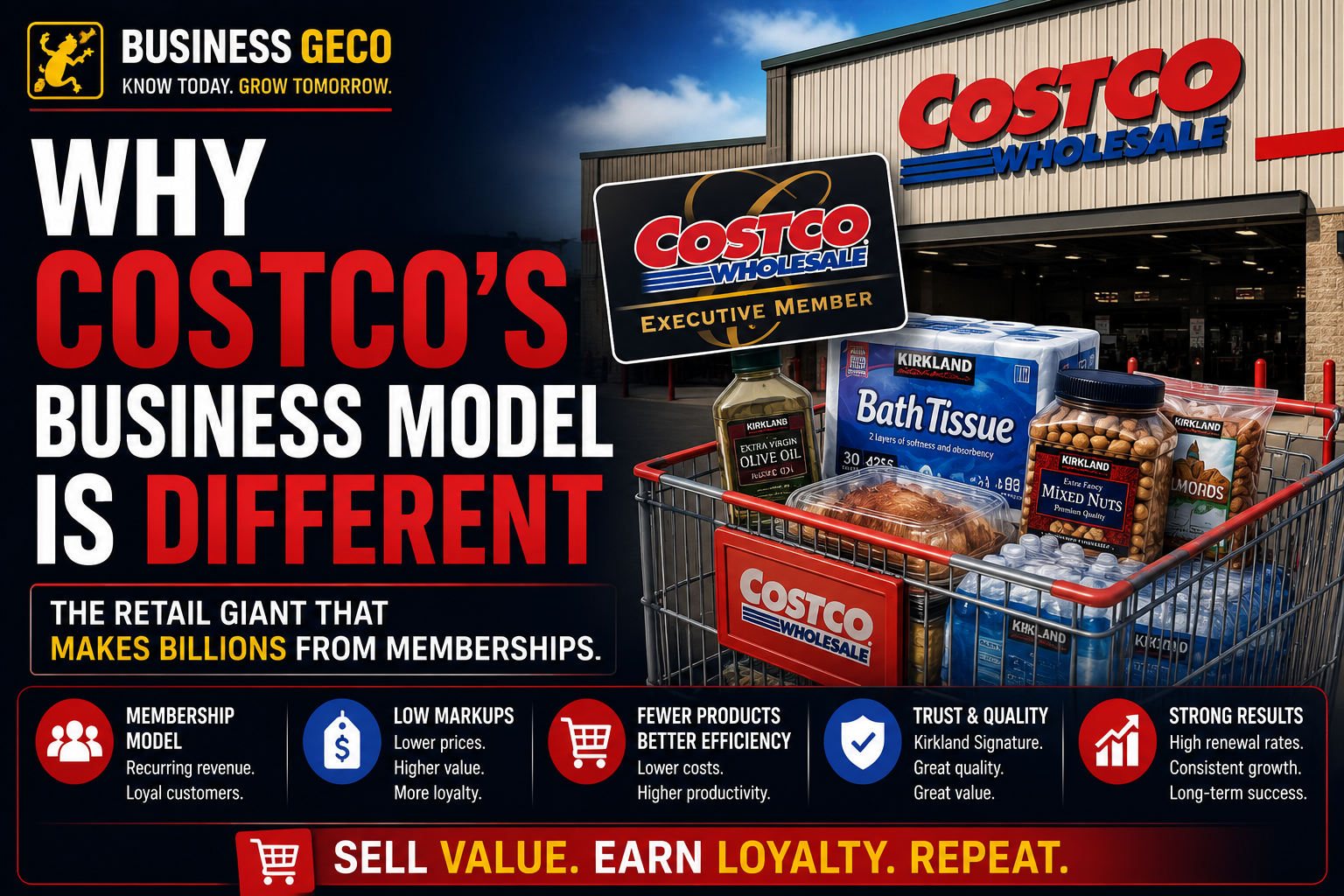
Why Costco’s Business Model Is So Different From Every Other Retail Giant

By Business Geco Editorial Team | Business & Retail
Introduction
Walk into a Costco warehouse on a weekend and you’ll see something unusual.
Shopping carts overflowing with groceries.
Customers buying giant packs of household essentials.
Long checkout lines.
And perhaps most surprising of all—people paying simply for the privilege of shopping there.
Unlike most retailers, Costco charges customers an annual membership fee before they can even enter its business model.
Yet millions of people happily renew their memberships every year.
Today, Costco has become one of the world’s largest retailers, generating hundreds of billions of dollars in annual revenue while maintaining one of the highest customer loyalty rates in the industry.
So what makes Costco so different?
The answer lies in a business model that focuses less on maximizing profits from products and more on building long-term customer trust.
Subscribe to our newsletter for 24×7 Alerts!
What Is Costco?
Costco is a membership-only warehouse retailer.
Instead of operating traditional supermarkets, Costco sells products in bulk at highly competitive prices.
Its warehouses offer everything from:
- Groceries
- Electronics
- Furniture
- Clothing
- Jewelry
- Pharmacy services
- Travel packages
The company serves tens of millions of members across multiple countries.
The Membership Model
Costco’s biggest competitive advantage isn’t its products.
It’s its members.
Customers pay an annual membership fee to shop in Costco stores.
Those membership fees generate billions of dollars every year.
More importantly, they provide predictable income regardless of day-to-day product sales.
This allows Costco to keep prices remarkably low.
Why Costco Can Sell Products So Cheap
Most retailers earn significant profits by marking up products.
Costco takes a different approach.
The company intentionally limits its product markups to relatively low levels.
Rather than making large profits on individual items, Costco relies heavily on membership revenue.
This strategy encourages customers to keep coming back because they know prices are consistently competitive.
Fewer Products, Better Efficiency
Walk into a traditional supermarket and you may find dozens of brands for the same product.
Costco offers far fewer choices.
Instead of stocking thousands of similar products, it focuses on a carefully selected inventory.
Benefits include:
- Faster inventory turnover
- Lower storage costs
- Better supplier negotiations
- Simpler shopping experience
This efficiency helps Costco reduce operating expenses.
The Power Of Kirkland Signature
One of Costco’s greatest success stories is its private-label brand:
Kirkland Signature.
The brand now includes hundreds of products ranging from food to clothing and household items.
Many Kirkland products are manufactured by well-known companies but sold under Costco’s own brand.
Because Costco controls the branding, it can often deliver premium quality at lower prices.
For many shoppers, Kirkland has become one of the biggest reasons to keep renewing memberships.
Customer Loyalty Is Everything
Costco’s business depends on renewals.
If customers stop renewing memberships, the model begins to weaken.
That’s why Costco focuses heavily on customer satisfaction.
The company has built a reputation for:
- Competitive pricing
- Generous return policies
- High-quality products
- Friendly customer service
This approach has resulted in exceptionally high membership renewal rates.
A Different Approach To Employees
Unlike many retailers, Costco has long been known for paying employees relatively competitive wages and offering benefits.
Management believes better treatment of employees leads to:
- Lower turnover
- Better customer service
- Higher productivity
While labor costs may be higher, the company argues the long-term benefits outweigh the expense.
Why Investors Love Costco
Costco has become one of Wall Street’s favorite retail companies.
Investors appreciate:
Predictable Membership Revenue
Recurring income creates stability.
Strong Customer Loyalty
Members return year after year.
Efficient Operations
Low costs support profitability.
Global Expansion
New warehouses continue opening around the world.
Together, these factors have helped Costco become one of the most valuable retailers globally.
The Challenges Ahead
Despite its success, Costco faces several challenges.
These include:
- Rising inflation
- Supply chain disruptions
- Competition from online retailers
- Expanding internationally
As consumer shopping habits evolve, Costco must continue balancing low prices with sustainable growth.
Lessons For Entrepreneurs
Costco’s success offers valuable lessons for businesses.
Build Trust
Customers return when they believe they’re getting genuine value.
Think Long-Term
Recurring revenue can create stability.
Keep It Simple
Fewer products can improve efficiency.
Focus On Loyalty
Retaining customers is often more profitable than constantly acquiring new ones.
These principles have helped Costco outperform many traditional retailers.
The Bottom Line
Costco’s success isn’t built on charging the highest prices.
It’s built on creating enough value that customers willingly pay to become members.
By combining low product markups, recurring membership revenue, efficient operations, and exceptional customer loyalty, Costco has created one of the most unique and successful retail business models in the world.
As retail continues evolving, Costco proves that sometimes the smartest strategy isn’t selling products for the highest possible profit.
It’s building a business that customers trust enough to keep coming back year after year.
Tags: Costco, Retail, Business Strategy, Membership Model, Kirkland Signature, Investing, Retail Industry, Business, Finance, Consumer Goods, Costco business model, Costco membership, Kirkland Signature, retail business, warehouse clubs, recurring revenue, retail strategy, Costco success, business explained, retail industry