



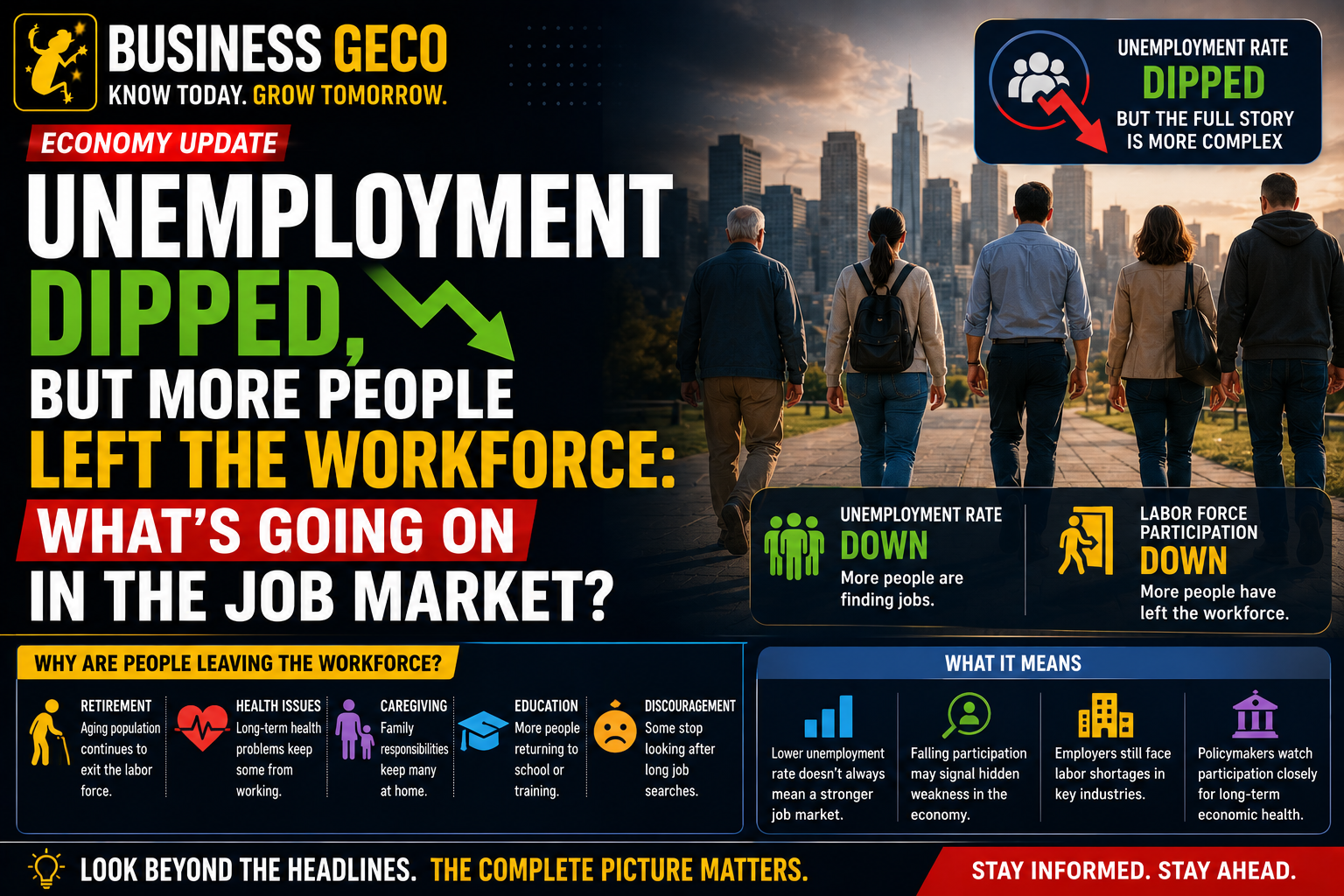
Unemployment Falls, But More Americans Leave The Workforce: What’s Happening In The Job Market?

By Business Geco Editorial Team | Economy & Employment
Introduction
The latest U.S. labor market data presents a mixed picture. While the unemployment rate has declined, another key indicator shows that more people are leaving the workforce, raising questions about the true strength of the job market.
Economists say the combination suggests that headline unemployment figures do not always tell the full story of employment conditions. A shrinking labor force can lower the unemployment rate even if fewer people are actively working or looking for jobs.
Subscribe to our newsletter for 24×7 Alerts!
Why Did Unemployment Fall?
The unemployment rate measures the percentage of people actively seeking work who cannot find a job.
A lower unemployment rate is generally viewed as a positive sign, indicating that more people are finding employment.
However, the figure can also decline if fewer people are actively looking for work.
What Does It Mean To Leave The Workforce?
People are considered part of the labor force only if they are:
- Employed, or
- Actively searching for a job.
When someone stops looking for work, they are no longer counted as unemployed and instead exit the labor force.
This means the unemployment rate can fall even without a large increase in hiring.
Why Are More People Leaving?
Economists point to several possible reasons for declining labor force participation, including:
- Retirement among older workers.
- Health-related issues.
- Family caregiving responsibilities.
- Returning to school or training.
- Discouragement after unsuccessful job searches.
Each of these factors can reduce the number of people actively participating in the labor market.
Why Labor Force Participation Matters
The labor force participation rate measures the share of the population that is either working or actively seeking employment.
A falling participation rate may indicate:
- Reduced availability of workers.
- Slower long-term economic growth.
- Labor shortages in certain industries.
- Hidden weakness beneath strong unemployment numbers.
For this reason, economists monitor participation alongside the unemployment rate when evaluating the health of the job market.
What Employers Are Seeing
Despite lower unemployment, many employers continue reporting challenges in finding qualified workers.
Some industries, including healthcare, construction, hospitality, and technology, continue to experience labor shortages even as overall hiring has slowed.
The mismatch between available jobs and available workers remains an important issue for policymakers.
The Bigger Picture
The latest employment figures suggest the U.S. labor market remains resilient but is becoming more complex.
Strong hiring in some sectors continues to support economic growth, while declining labor force participation raises questions about the availability of workers and the long-term outlook for productivity.
Future employment reports will be closely watched for signs of whether participation begins to recover.
The Bottom Line
A lower unemployment rate is generally positive, but it does not always mean the labor market is strengthening across the board.
With more Americans leaving the workforce, economists are looking beyond the headline unemployment figure to assess the true health of the U.S. job market. Labor force participation will remain a key indicator as businesses, workers, and policymakers navigate an evolving economic landscape.
Tags: Unemployment, Jobs, Labor Market, Workforce, Economy, Employment, United States, Business News, Economic Data, unemployment rate, labor force participation, U.S. jobs report, employment, economy, workforce, labor market, hiring, economic news, Business Geco