


How McDonald’s Makes Billions Every Year Without Primarily Selling Burgers

By Business Geco Editorial Team | Business & Finance
Introduction
Ask someone how McDonald’s makes money, and the answer is almost always the same.
“By selling burgers and fries.”
While that’s true, it isn’t the whole story.
Behind the Big Macs and Happy Meals lies one of the smartest business models ever created.
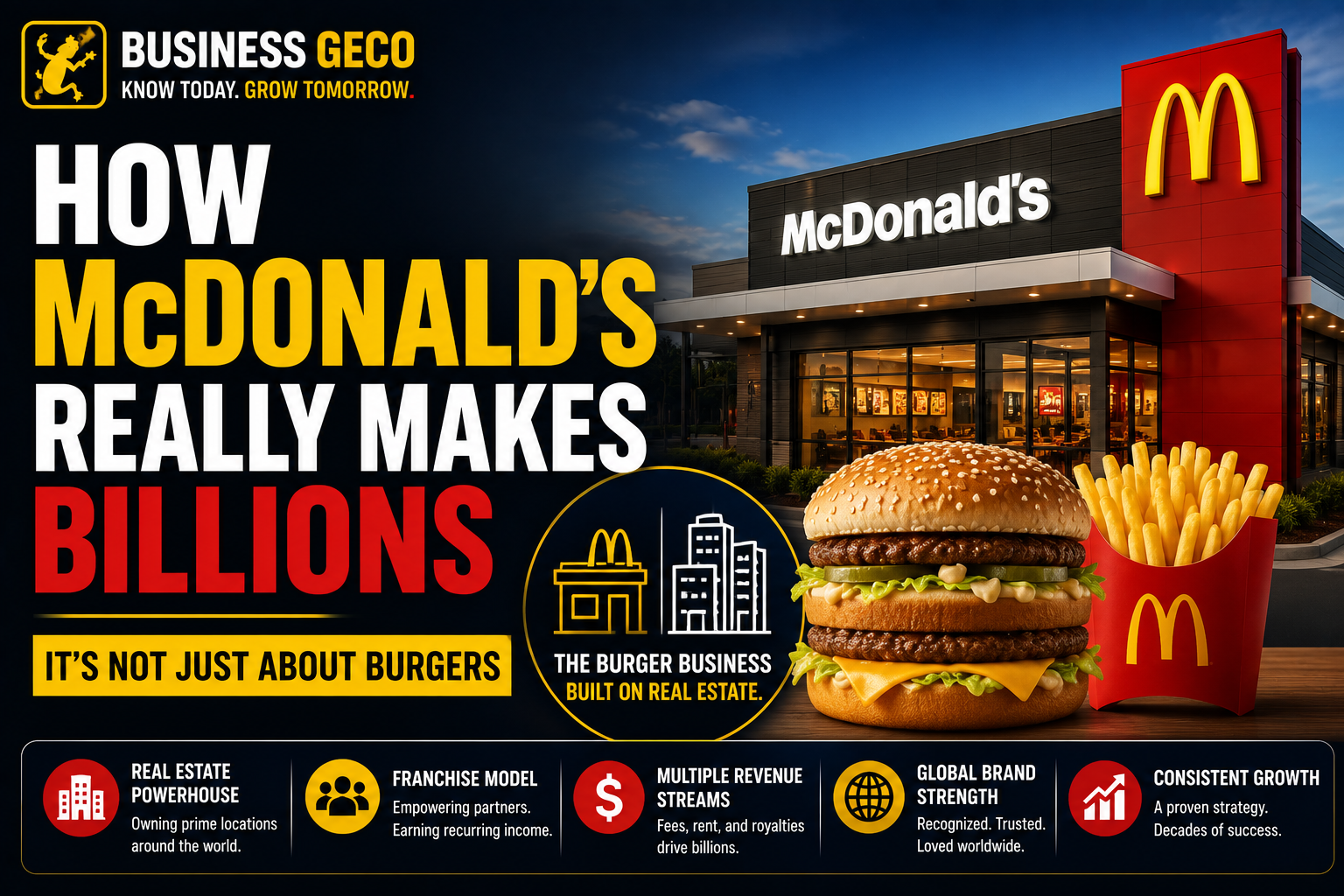
In fact, many analysts describe McDonald’s as one of the world’s largest real estate companies that also happens to sell burgers.
Today, McDonald’s operates more than 40,000 restaurants across over 100 countries.
It serves millions of customers every day.
But the company’s greatest strength isn’t food.
It’s real estate.
Understanding this strategy helps explain why McDonald’s has become one of the most successful businesses in history.
Subscribe to our newsletter for 24×7 Alerts!
The Birth Of McDonald’s
McDonald’s began as a small restaurant in California during the 1940s.
The business changed forever when entrepreneur Ray Kroc joined the company in the 1950s.
Kroc saw something much bigger than a successful burger restaurant.
He saw a franchise opportunity that could expand worldwide.
His vision transformed McDonald’s into a global brand.
The Franchise Model
Today, the vast majority of McDonald’s restaurants are owned by franchisees.
Instead of operating every restaurant itself, McDonald’s allows independent business owners to run locations under its brand.
Franchisees receive:
- Brand recognition
- Operating systems
- Marketing support
- Supply chain access
- Training
In return, they pay fees and rent to McDonald’s.
The Real Estate Strategy
Here’s where McDonald’s becomes unique.
Rather than simply licensing its brand, McDonald’s often purchases or leases the land where restaurants are built.
It then rents that property to franchise operators.
This creates multiple revenue streams:
- Franchise fees
- Rent payments
- Royalties based on restaurant sales
Even if food margins fluctuate, rental income remains relatively stable.
That’s why many investors consider McDonald’s a real estate business as much as a restaurant company.
Why Real Estate Matters
Owning valuable commercial property provides several advantages.
McDonald’s benefits from:
- Long-term property appreciation
- Predictable rental income
- Greater control over restaurant locations
- Strong negotiating power
Prime real estate has become one of the company’s most valuable assets.
Standardization Is The Secret
Walk into a McDonald’s in Tokyo, London, New York, or Mumbai.
The experience feels familiar.
That’s intentional.
McDonald’s has built one of the world’s most standardized operating systems.
From kitchen layouts to food preparation procedures, consistency remains a top priority.
Customers know what to expect almost anywhere in the world.
The Power Of Scale
Because McDonald’s purchases enormous quantities of ingredients, it enjoys significant bargaining power.
Large-scale purchasing helps reduce costs on:
- Beef
- Potatoes
- Packaging
- Soft drinks
- Kitchen equipment
Lower costs improve profitability across the franchise network.
More Than Burgers
Although burgers remain its signature product, McDonald’s has expanded its menu significantly.
Today, customers can purchase:
- Breakfast meals
- Chicken products
- Coffee
- Desserts
- Salads
- Regional menu items
Adapting menus to local markets has helped McDonald’s grow internationally.
Digital Transformation
McDonald’s has invested heavily in technology.
The company now focuses on:
- Mobile ordering
- Delivery partnerships
- Self-service kiosks
- Loyalty programs
- Artificial intelligence
These investments improve customer convenience while helping restaurants operate more efficiently.
Why Investors Like McDonald’s
McDonald’s remains one of the world’s favorite dividend stocks.
Reasons include:
Strong Global Brand
Recognized almost everywhere.
Recurring Franchise Revenue
Stable income from royalties and rent.
Real Estate Assets
Valuable commercial property portfolio.
Global Expansion
Continued growth in developing markets.
Together, these strengths create a resilient business model.
Challenges Ahead
Despite its success, McDonald’s faces ongoing challenges.
These include:
- Rising labor costs
- Inflation
- Health-conscious consumers
- Increasing competition
- Changing eating habits
The company continues adapting through menu innovation and technology investments.
Lessons For Entrepreneurs
McDonald’s offers several important business lessons.
Own Valuable Assets
Real estate created long-term wealth.
Build Systems
Consistency beats complexity.
Scale Efficiently
Franchising accelerated global expansion.
Think Beyond The Product
The biggest profits often come from the business model—not the product itself.
These lessons apply far beyond the restaurant industry.
The Bottom Line
McDonald’s became one of the world’s most successful companies by building a business model that extends far beyond burgers.
Its combination of franchising, real estate ownership, operational efficiency, and global brand recognition has created a company that generates billions of dollars every year.
While customers come for burgers and fries, the real engine behind McDonald’s success is its ability to combine food, property, and franchising into one of the smartest business strategies ever developed.
It’s a reminder that sometimes the greatest businesses aren’t defined by what they sell.
They’re defined by how they make money.
Tags: McDonald’s, Business Strategy, Ray Kroc, Franchising, Real Estate, Investing, Restaurants, Global Business, Finance, Entrepreneurship, McDonald’s business model, Ray Kroc, McDonald’s real estate, franchise business, McDonald’s makes money, restaurant business, business strategy, franchising, global brands, retail business