



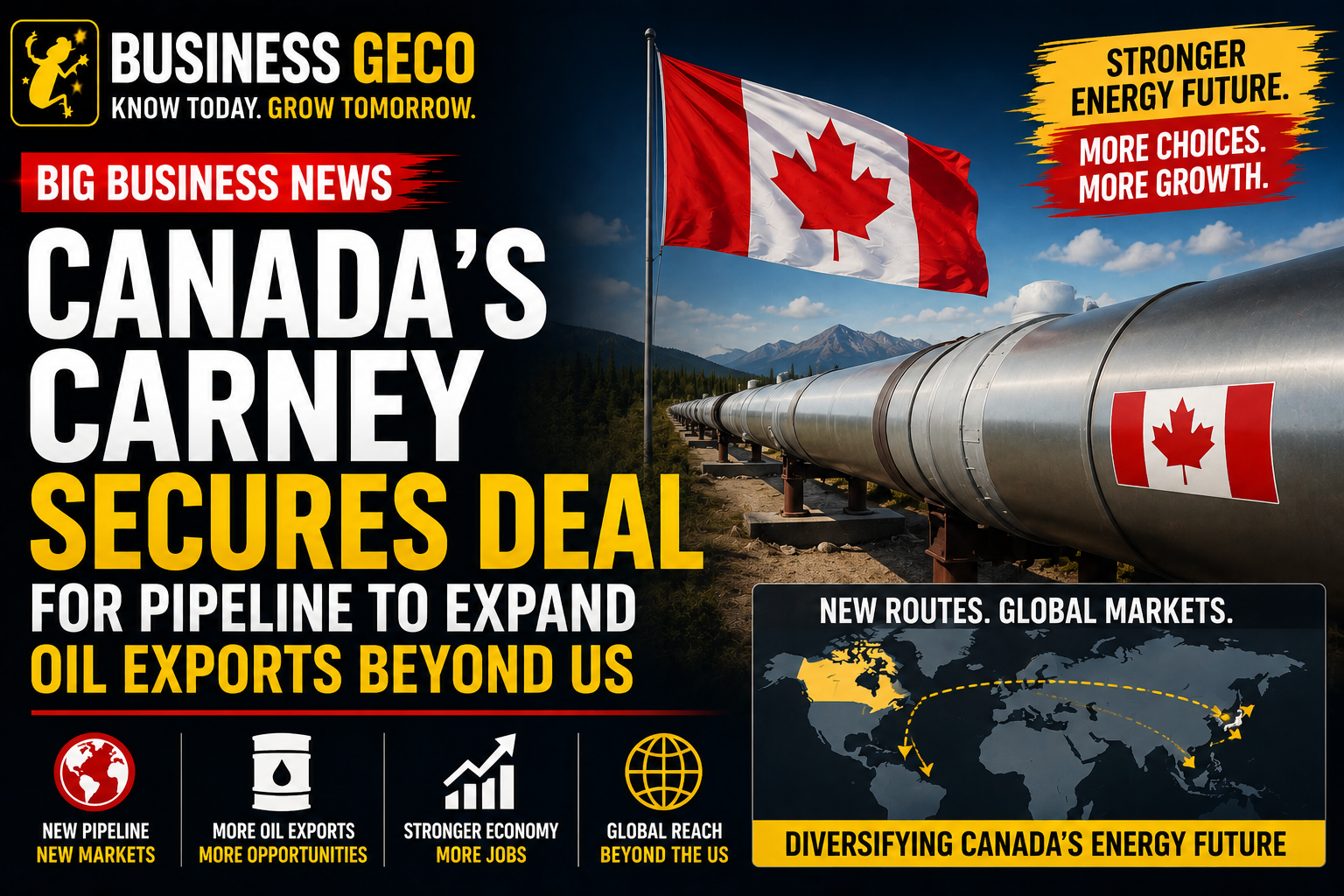
Canada Secures Pipeline Deal To Expand Oil Exports Beyond The U.S.

By Business Geco Editorial Team | Energy & Global Economy
Introduction
Canada has reached a major agreement to expand its oil export capacity beyond the United States, marking an important step in diversifying the country’s energy markets.
Prime Minister Mark Carney announced a deal supporting pipeline infrastructure that will allow Canadian producers to reach more international customers, reducing reliance on the U.S. as the primary destination for Canadian crude oil.
The move is expected to strengthen Canada’s energy sector while opening new opportunities in global markets.
Subscribe to our newsletter for 24×7 Alerts!
A Major Shift In Canada’s Energy Strategy
For decades, the United States has been the largest buyer of Canadian crude oil.
The new pipeline agreement is designed to help Canada:
- Expand exports to overseas markets by enabling oil shipments to reach countries outside North America, particularly in Asia and Europe.
- Reduce dependence on a single trading partner, which lowers economic risk if demand from the U.S. declines.
- Increase access to Asian and European buyers, where growing energy needs could create new long-term demand.
- Improve long-term energy security by ensuring Canada has multiple outlets for its oil production.
- Support future growth in the country’s oil industry by encouraging investment and production expansion.
Officials say greater export flexibility could make Canada’s energy sector more competitive globally.
Why Diversification Matters
Relying heavily on one export market can expose producers to:
- Trade disputes, which can disrupt exports or lead to tariffs and restrictions.
- Policy changes, such as environmental regulations or import limits imposed by a single country.
- Price volatility, where dependence on one buyer can lead to less favorable pricing conditions.
- Transportation bottlenecks, especially if infrastructure is limited to one direction or route.
- Supply chain disruptions, which can affect delivery timelines and reliability.
By reaching additional international markets, Canadian oil producers may benefit from stronger pricing and increased demand.
Economic Benefits
The pipeline project is expected to generate several economic advantages, including:
- Increased energy exports, leading to higher overall sales of Canadian oil.
- Higher government revenues through taxes, royalties, and export earnings.
- Job creation in construction and energy sectors during both development and operation phases.
- Greater investment in infrastructure, including pipelines, ports, and related facilities.
- Improved long-term competitiveness by positioning Canada as a more flexible and reliable supplier.
Energy remains one of Canada’s largest export industries and a significant contributor to the national economy.
Environmental Debate Continues
As with many major pipeline projects, the agreement has sparked debate.
Supporters argue the project will strengthen Canada’s economy and energy security, while critics continue raising concerns about environmental impacts, emissions, and long-term climate goals.
The government says environmental standards and regulatory oversight will remain an important part of future development.
Global Energy Demand
The announcement comes as countries around the world continue balancing the transition to cleaner energy with ongoing demand for oil and natural gas.
Despite growing investment in renewable energy, crude oil remains essential for transportation, manufacturing, and industrial production across much of the world.
What Comes Next?
The success of the agreement will depend on:
- Pipeline construction and expansion, ensuring the infrastructure is completed on time and within budget.
- Regulatory approvals, which are required from government bodies before construction and operation can proceed.
- Global oil prices, as higher prices can make exports more profitable.
- International demand, particularly from new markets Canada aims to reach.
- Future investment in Canada’s energy sector, which will support continued growth and development.
Analysts believe expanding export routes could strengthen Canada’s position as a reliable global energy supplier.
The Bigger Picture
The deal reflects Canada’s broader effort to diversify its economy and reduce dependence on a single export market.
By improving access to international buyers, the country hopes to increase resilience against changing geopolitical and economic conditions while supporting long-term growth in its energy industry.
The Bottom Line
Prime Minister Mark Carney has secured a pipeline agreement aimed at expanding Canada’s oil exports beyond the United States, a move that could reshape the country’s energy trade strategy.
If successfully implemented, the project is expected to provide Canadian producers with greater access to global markets while strengthening the nation’s role as a major energy exporter.
Tags: Canada, Mark Carney, Oil, Pipeline, Energy, Crude Oil, Global Economy, Exports, Business News, Canada pipeline, Mark Carney, Canada oil exports, crude oil, energy exports, Canadian energy, oil pipeline, global energy, business news, Business Geco