



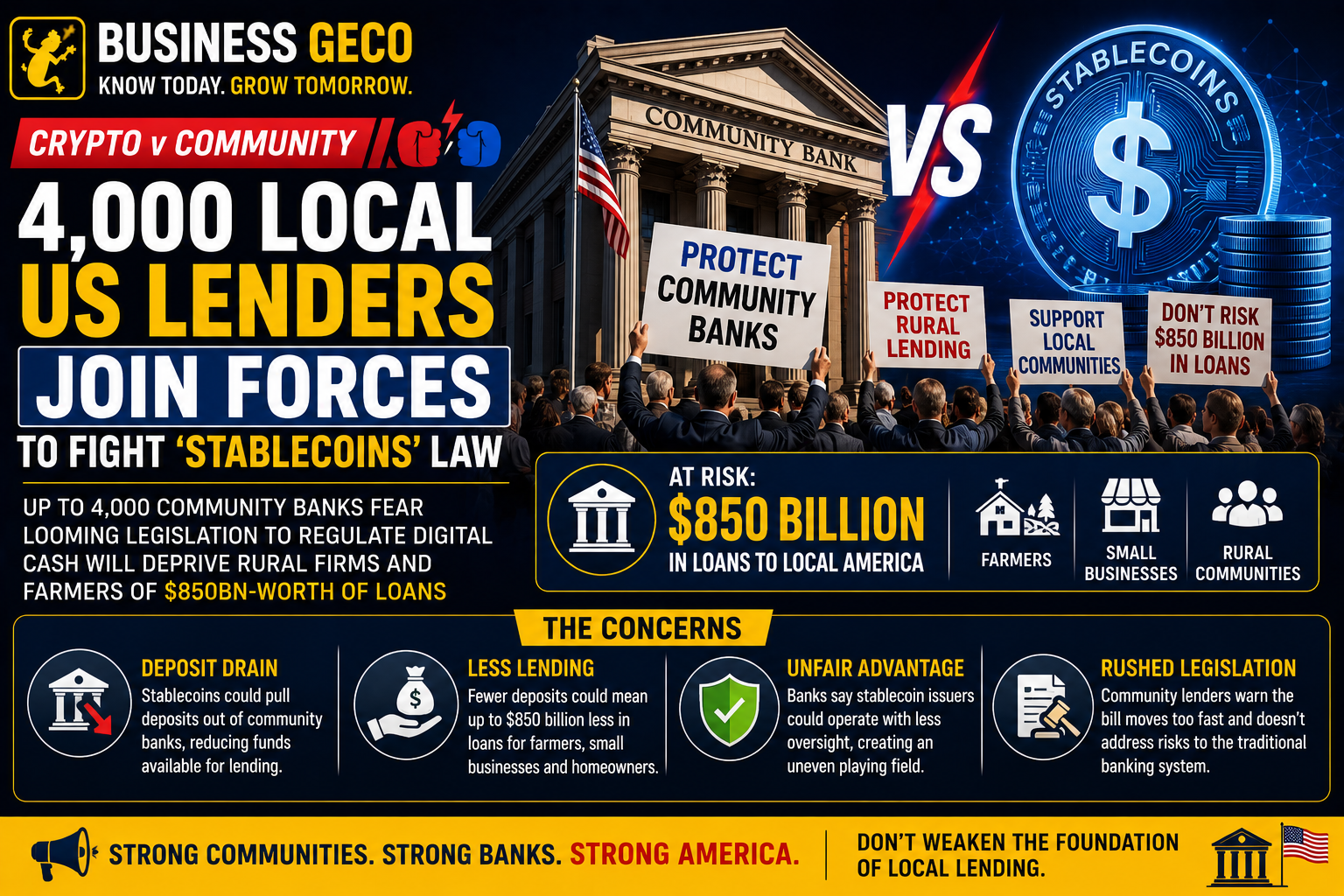
Thousands Of U.S. Community Banks Push Back Against Stablecoin Legislation, Warning Of $850 Billion Lending Risk

By Business Geco Editorial Team | Banking & Cryptocurrency
Introduction
A growing dispute is emerging between the traditional banking industry and the cryptocurrency sector in the United States.
Nearly 4,000 community banks have joined forces to oppose proposed legislation aimed at creating a regulatory framework for stablecoins, arguing that the law could significantly reduce bank deposits and threaten lending to rural businesses, farmers, and local communities.
According to industry groups representing community lenders, wider adoption of stablecoins could divert customer deposits away from local banks, putting as much as $850 billion in loans at risk over time.
The debate highlights the increasing tension between financial innovation and the traditional banking system as digital assets become more mainstream.
Subscribe to our newsletter for 24×7 Alerts!
Why Community Banks Are Concerned
Community banks play a critical role in the U.S. financial system.
Unlike large national banks, they primarily serve:
- Small businesses
- Farmers
- Local entrepreneurs
- Rural communities
- Residential borrowers
These banks rely heavily on customer deposits to fund loans.
Their concern is that if consumers begin holding significant amounts of money in stablecoins instead of traditional bank accounts, deposit levels could decline substantially.
Less money on deposit means less capital available for lending.
What Are Stablecoins?
Stablecoins are cryptocurrencies designed to maintain a stable value by being linked to traditional assets such as the U.S. dollar.
Unlike Bitcoin or Ethereum, whose prices can fluctuate significantly, stablecoins aim to maintain a relatively fixed price.
They are commonly used for:
- Digital payments
- Cross-border transfers
- Cryptocurrency trading
- Decentralized finance (DeFi)
- Settlement between financial institutions
Supporters believe stablecoins could make payments faster, cheaper, and more efficient.
The $850 Billion Warning
Banking groups argue that widespread migration from traditional deposits into stablecoins could reduce funding available for community lending.
According to their estimates, up to $850 billion in loans supporting local economies—including agriculture, housing, and small businesses—could eventually be affected if deposits shift significantly toward digital cash.
Industry representatives say community banks cannot easily replace those lost deposits through alternative funding sources.
The Other Side Of The Debate
Supporters of stablecoin legislation disagree with the banking industry’s concerns.
They argue that:
- Stablecoins improve payment efficiency.
- Digital assets encourage financial innovation.
- Competition benefits consumers.
- Clear regulation will strengthen the U.S. financial system.
Technology companies and many cryptocurrency firms believe regulated stablecoins could modernize payments while maintaining financial stability.
Why Lawmakers Want Stablecoin Rules
Congress has been working on legislation to establish clear rules for stablecoin issuers.
Proposed regulations generally focus on:
- Reserve requirements
- Consumer protection
- Transparency
- Financial supervision
- Anti-money laundering compliance
The goal is to create confidence in digital payment systems while reducing risks to consumers and the broader financial system.
A Clash Between Old And New Finance
The debate reflects a broader transformation occurring across global finance.
Traditional banks depend on customer deposits to generate loans.
Cryptocurrency companies seek to build alternative financial infrastructure using blockchain technology.
Both industries believe they play an important role in the future of money.
The challenge for policymakers is balancing innovation with financial stability.
What This Means For Consumers
For most consumers, the debate may not immediately change how they use money.
However, the outcome of stablecoin legislation could influence:
- Digital payment options
- Banking competition
- Cryptocurrency adoption
- Loan availability
- Financial innovation
The final legislation may shape the future relationship between traditional banks and blockchain-based financial services.
The Bigger Picture
Stablecoins have become one of the fastest-growing areas of cryptocurrency.
Major financial institutions, fintech companies, and payment providers are increasingly exploring blockchain-based payment systems.
At the same time, community banks argue that rapid changes to the financial system should not undermine the local lending model that supports millions of Americans.
The debate demonstrates how digital assets are no longer just a technology story—they are becoming a major public policy issue.
The Bottom Line
Nearly 4,000 U.S. community banks are urging lawmakers to reconsider proposed stablecoin legislation, warning that widespread adoption of digital cash could reduce bank deposits and put up to $850 billion in local lending at risk.
Supporters of the legislation argue that regulated stablecoins represent the future of payments and financial innovation, while community banks believe protecting traditional deposit-based lending remains essential for rural economies and small businesses.
As lawmakers continue debating the legislation, the outcome could significantly influence the future of both American banking and the cryptocurrency industry.
Tags: Stablecoins, Cryptocurrency, Banking, Community Banks, U.S. Congress, Digital Assets, Blockchain, Finance, Regulation, Business Geco, stablecoin law, community banks, stablecoins, cryptocurrency regulation, U.S. banking, digital cash, crypto news, banking industry, blockchain payments, financial regulation