



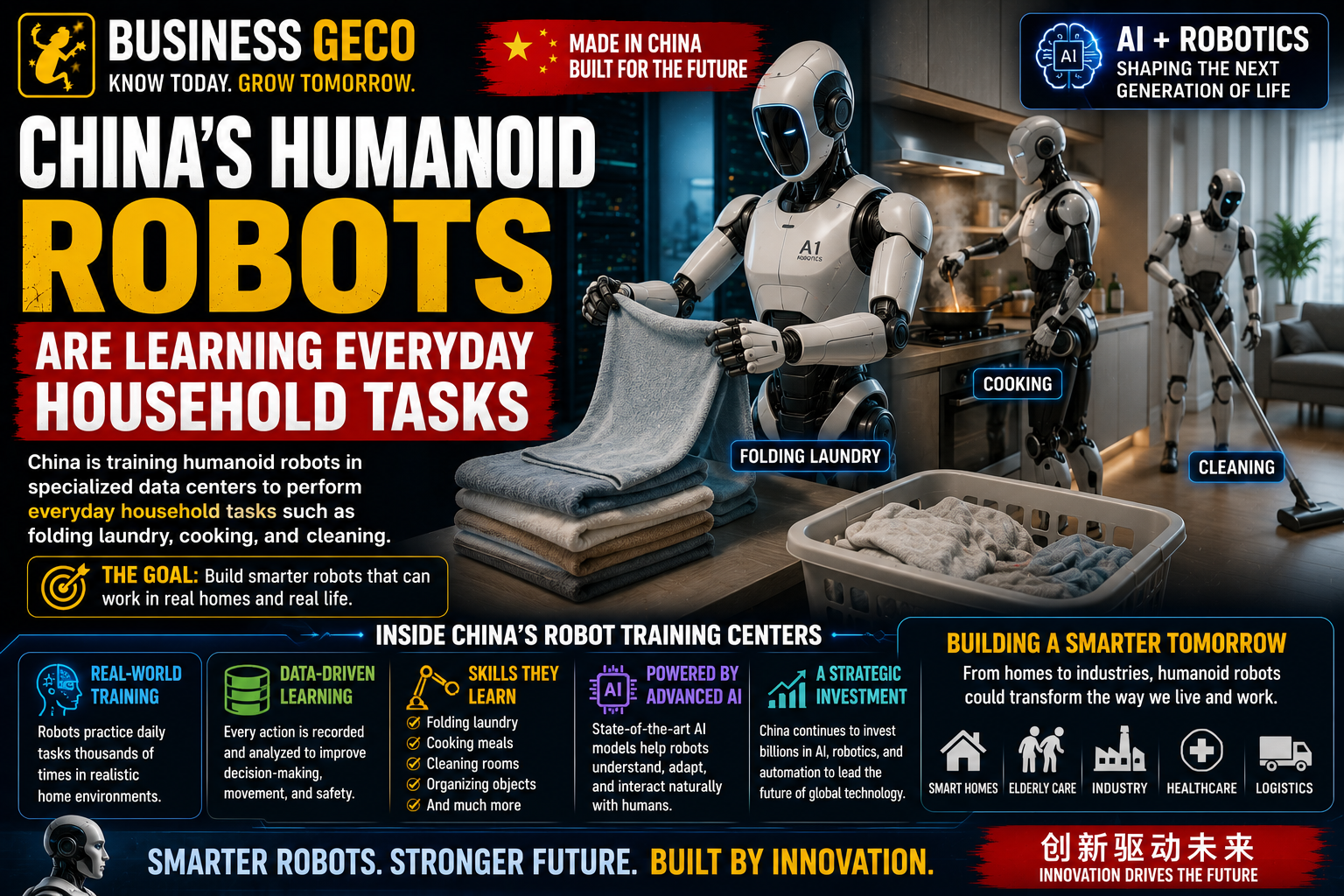
China’s Humanoid Robots Are Learning To Cook, Clean And Fold Laundry In AI Training Centers

By Business Geco Editorial Team | Artificial Intelligence & Technology
Introduction
China is accelerating its push into the next generation of artificial intelligence by training humanoid robots in specialized data centers designed to teach them everyday household tasks.
The robots are reportedly being trained to perform activities such as folding laundry, cooking meals, cleaning homes, organizing objects, and assisting with daily chores. The goal is to improve their ability to operate in real-world environments as China continues investing heavily in AI and robotics.
The initiative reflects China’s broader ambition to become a global leader in intelligent robotics over the coming decade.
Subscribe to our newsletter for 24×7 Alerts!
How The Training Works
Unlike traditional industrial robots that perform repetitive factory tasks, humanoid robots must learn to operate in unpredictable environments.
To achieve this, developers are using specialized training facilities where robots repeatedly practice common household activities.
These tasks include:
- Folding clothes
- Washing dishes
- Cleaning rooms
- Cooking simple meals
- Organizing household items
- Picking up and moving objects
Each completed task generates valuable data that helps improve the robots’ decision-making and movement.
Why Data Centers Matter
Modern humanoid robots rely on enormous amounts of data to learn.
Every movement, mistake, and successful action is recorded and analyzed.
Engineers then use this information to train AI models that allow robots to:
- Understand objects
- Improve hand coordination
- Navigate complex environments
- Adapt to changing situations
- Interact more naturally with people
The more real-world data robots receive, the more capable they become.
China’s AI And Robotics Strategy
China has made artificial intelligence and robotics national priorities.
The country has invested billions of dollars into:
- AI research
- Semiconductor development
- Robotics manufacturing
- Automation
- Smart factories
Officials view humanoid robots as an important technology that could support future economic growth while helping address labor shortages caused by an aging population.
Potential Real-World Applications
If successfully developed, humanoid robots could assist in a wide range of industries.
Possible uses include:
- Home assistance
- Elderly care
- Hospitals
- Hotels
- Warehouses
- Manufacturing
- Retail
- Disaster response
Experts believe household robots could eventually become as common as smart home devices are today.
Challenges Still Remain
Despite rapid progress, humanoid robots still face significant technical hurdles.
Current limitations include:
- High production costs
- Battery life
- Slow decision-making
- Complex hand movements
- Safe interaction with humans
Developers continue working to make robots faster, safer, and more reliable before large-scale consumer adoption becomes practical.
A Growing Global Race
China is not alone in developing humanoid robots.
Technology companies in the United States, Japan, South Korea, and Europe are also investing heavily in AI-powered robotics.
Competition is increasing as governments and private companies view intelligent robots as one of the next major technological breakthroughs after generative AI.
The Bigger Picture
The rapid development of humanoid robots demonstrates how artificial intelligence is expanding beyond software into the physical world.
As AI models become more capable, robots may increasingly perform tasks that previously required human workers.
While widespread household adoption could still take several years, advances in training methods are bringing that future closer.
The Bottom Line
China is training humanoid robots in specialized AI data centers to perform everyday household tasks such as cooking, cleaning, and folding laundry.
The initiative highlights the country’s growing investment in artificial intelligence and robotics as it seeks to build smarter machines capable of operating in real-world environments.
As competition in AI accelerates globally, humanoid robots are expected to become one of the most important technologies shaping the future of work and daily life.
Tags: China, AI, Humanoid Robots, Robotics, Artificial Intelligence, Technology, Automation, Innovation, Future Tech, Business Geco, China AI, humanoid robots, robotics, artificial intelligence, household robots, AI training, robotics industry, China technology, automation, Business Geco