



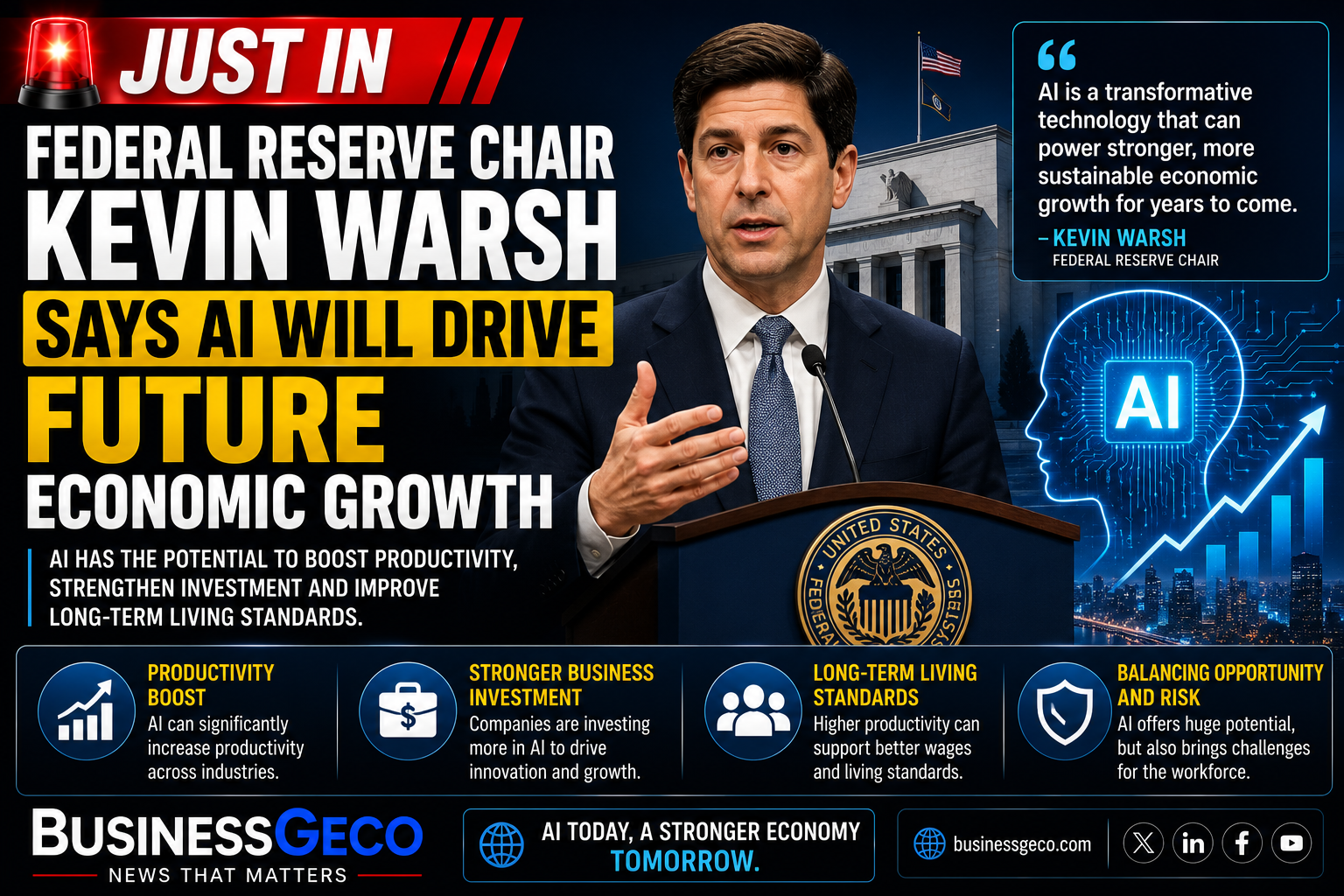
Federal Reserve Chair Kevin Warsh Says AI Will Drive Future Economic Growth

WASHINGTON, D.C. — Federal Reserve Chair Kevin Warsh said he believes artificial intelligence (AI) will be a major driver of future economic growth, arguing that the technology has the potential to boost productivity, strengthen business investment, and improve long-term living standards.
Warsh said AI should be viewed as a transformative technology that can reshape industries, increase efficiency, and support sustainable economic expansion, while acknowledging that its full impact will unfold over time.
Subscribe to our newsletter for 24×7 Alerts!
AI as a Productivity Engine
According to Warsh, AI has the potential to deliver significant productivity gains across a wide range of sectors, from manufacturing and finance to healthcare and logistics.
He suggested that stronger productivity growth could support higher wages, greater business output, and faster long-term economic growth without necessarily generating persistent inflation.
Long-Term Economic Outlook
Warsh emphasized that while AI investment is expanding rapidly, the technology’s greatest economic benefits are likely to emerge over the coming years as businesses integrate AI into everyday operations.
He has also established a Federal Reserve task force to study the economic effects of AI and other emerging technologies as policymakers evaluate their implications for employment, productivity, and inflation.
Balancing Opportunity and Risk
Despite his optimism, Warsh noted that AI’s economic impact is not guaranteed. Businesses must continue investing in innovation, workforce development, and infrastructure to fully realize the technology’s potential.
Economists also point out that AI could reshape labor markets, requiring workers and companies to adapt as automation and new technologies become more widespread.
Why It Matters
The Federal Reserve closely monitors long-term productivity because stronger economic output can influence inflation, employment, wages, and future monetary policy.
If AI delivers the productivity gains many expect, it could become one of the most significant drivers of global economic growth over the next decade.
Conclusion
Kevin Warsh’s comments reflect growing optimism among policymakers that artificial intelligence can become a powerful engine for economic growth. While challenges remain, AI is increasingly viewed as a technology capable of transforming productivity, investment, and the broader economy in the years ahead.
Tags: Kevin Warsh, Federal Reserve, Artificial Intelligence, Economy, Productivity, Economic Growth, Business News, BusinessGeco, Kevin Warsh, Federal Reserve, AI, artificial intelligence, economic growth, productivity, business investment, U.S. economy