



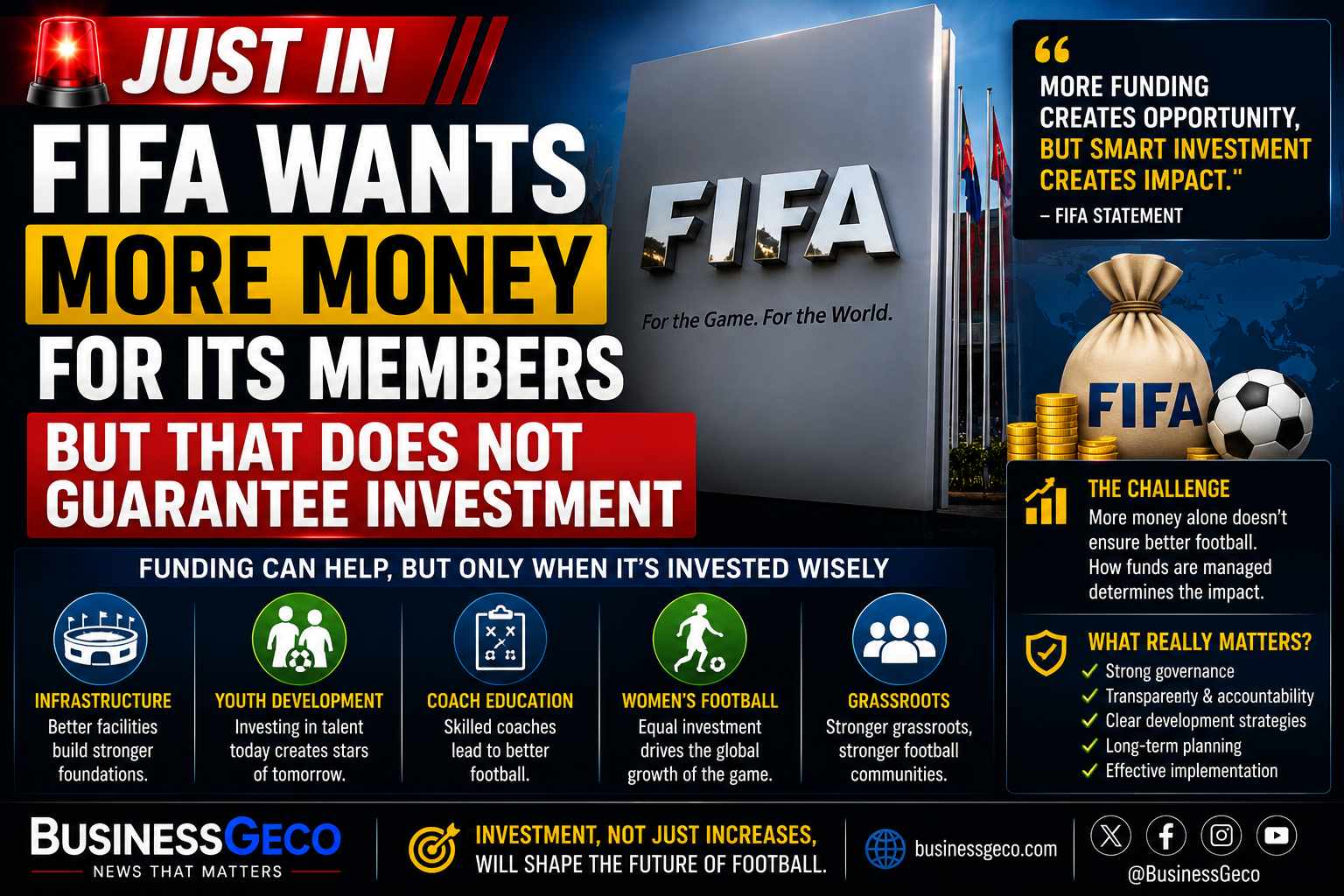
FIFA Wants More Money for Its Members, but That Does Not Guarantee Investment

ZURICH — FIFA has continued its push to increase financial support for its member associations, promising greater funding through its development programs. However, experts caution that more money does not automatically translate into better investment or long-term growth for football around the world.
While increased funding can help improve infrastructure, youth development, and grassroots programs, the effectiveness of these investments ultimately depends on how the funds are managed.
Subscribe to our newsletter for 24×7 Alerts!
FIFA’s Growing Financial Ambitions
Over recent years, FIFA has expanded its revenues through larger tournaments, commercial partnerships, and broadcasting rights. The organization has repeatedly stated that a significant portion of these earnings should be redistributed to its 211 member associations.
The goal is to strengthen football development globally and reduce disparities between wealthier and smaller football nations.
More Funding Doesn’t Guarantee Results
Although additional funding provides opportunities for investment, financial experts note that success depends on transparency, governance, and strategic planning.
Without proper oversight, increased funding may fail to deliver meaningful improvements in areas such as:
- Youth academies
- Coaching education
- Stadium infrastructure
- Women’s football
- Grassroots development
Simply allocating more money does not ensure sustainable progress if resources are not used effectively.
Governance Remains Key
Sports governance specialists argue that accountability and long-term planning are just as important as financial support.
Member associations with clear development strategies, transparent financial reporting, and measurable objectives are generally more likely to convert FIFA funding into lasting improvements.
Global Football Faces Different Challenges
Every member association has unique priorities. While some require basic infrastructure and training facilities, others focus on elite player development, technology, or expanding professional leagues.
As a result, investment strategies must be tailored to local needs rather than relying solely on larger funding allocations.
Looking Ahead
As FIFA continues to generate record revenues, expectations are rising for member associations to demonstrate how development funds are being used.
The debate is likely to focus not only on how much money FIFA distributes, but also on whether those investments produce measurable results that strengthen football over the long term.
Conclusion
FIFA’s commitment to increasing financial support for its member associations reflects its ambition to grow the global game. However, experts emphasize that funding alone is not enough. Sustainable development depends on responsible governance, strategic investment, and effective implementation at the national level.
Tags: FIFA, Football, Sports Business, Football Development, Member Associations, Governance, Investment, BusinessGeco, FIFA, FIFA funding, member associations, football development, sports governance, football investment, world football